
Overview
Summary generated from the READMEAdds read-only createdBy and lastModifiedBy relationship fields to collections and globals, set automatically from the acting user. It replaces the versions list view with a recreation that shows who saved each version. Users are shown by email as links to their documents, customizable through a label resolver. Requires Payload 3.27 or later.
Features
- Adds createdBy and lastModifiedBy fields to all collections and globals by default, with include and exclude options
- Modified By column in the versions list view, linked to the user document
- Supports multiple auth collections through polymorphic user references
- Custom attribution and label resolvers, including async ones, for jobs or bot users
- Strips incoming createdBy values on update so attribution cannot be rewritten
- Stores data in the same shape as @payload-bites/audit-fields, so switching needs no migration
Use cases
- Show editors who last changed a document and who created it
- Review which user saved each version in the versions history
- Attribute background job or webhook writes to a dedicated system user
From the author
Payload plugin that tracks who created and last modified every document, with an enhanced versions view showing who modified each version.
Installation
npm i @whatworks/payload-audit-fields15
Stars
1
Forks
1
Open Issues
2 weeks ago
Last Updated
0
Weekly Downloads
v0.2.0
npm Version
141.2 KB
Unpacked Size
0
Dependencies
Trends (last 90 days)
Trends appear after 7 days of data. Daily snapshots have not started yet.
Shared by 12 plugins in what-works-global/payload-packages.
Trends appear after 7 days of data. Daily snapshots have not started yet.
Each point is npm's rolling 7-day download count.
Health Score
Composite score based on GitHub activity, stars, npm downloads, publish recency, dependency count, and package size.
Badge for your README

[](https://payloaddirectory.dev/plugins/1064440892-audit-fields)<a href="https://payloaddirectory.dev/plugins/1064440892-audit-fields"><img src="https://payloaddirectory.dev/badge/1064440892-audit-fields.svg" alt="Payload Directory"></a>README
@whatworks/payload-audit-fields

Payload plugin that records who created and who last modified every document, and upgrades the versions list view with a Modified By column so you can see exactly who saved each version.
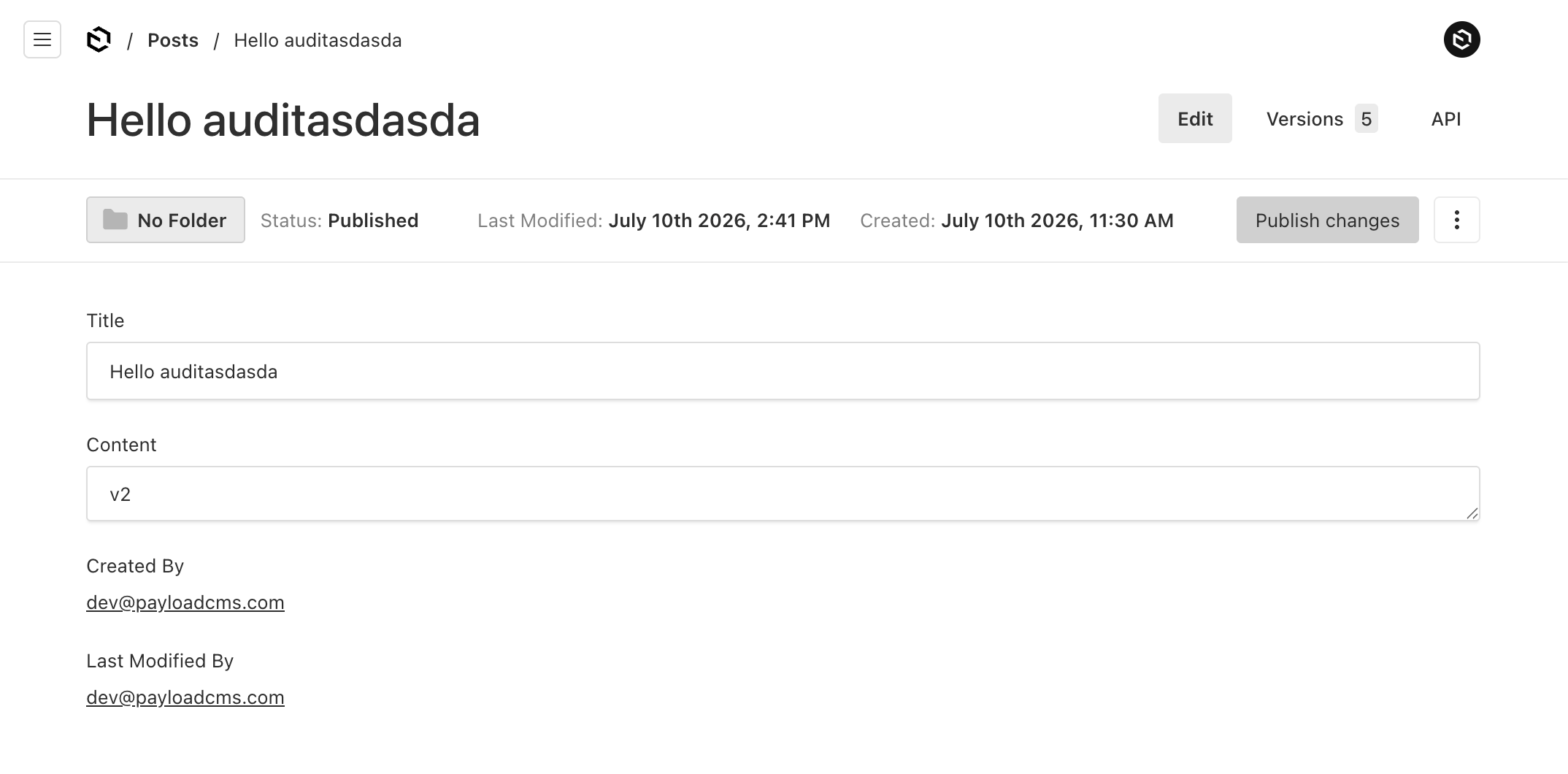
- Adds read-only
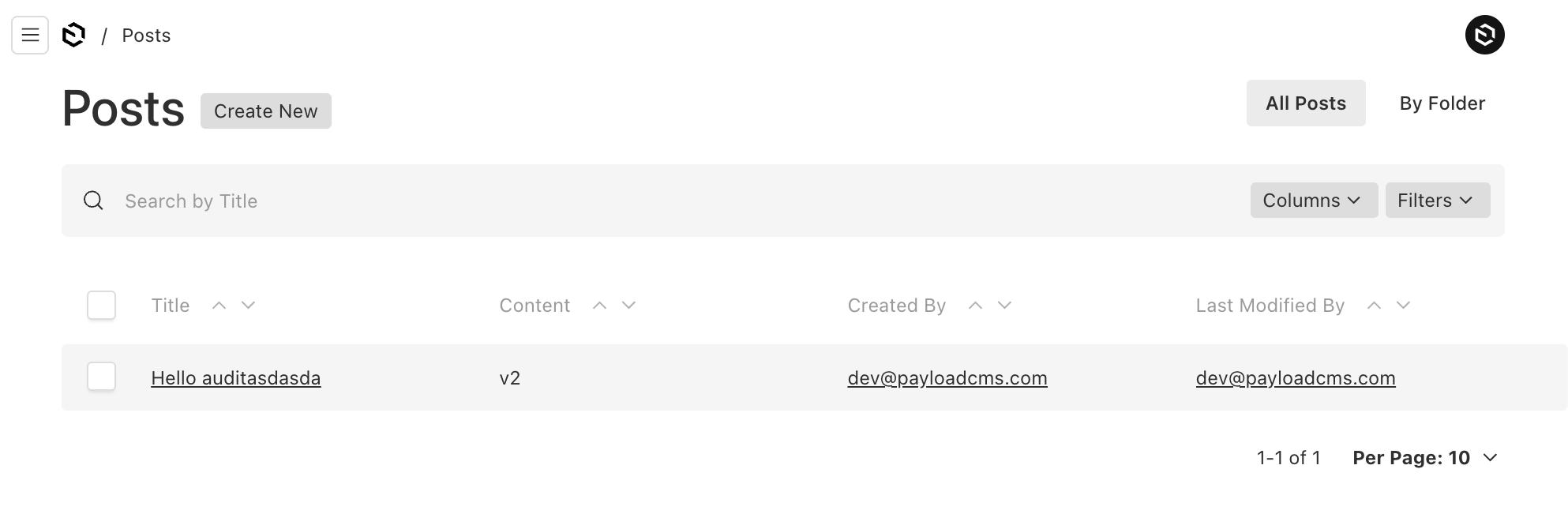
createdBy/lastModifiedByrelationship fields to every collection and global by default (opt-out, not opt-in). - Displays attributed users by email (customizable via
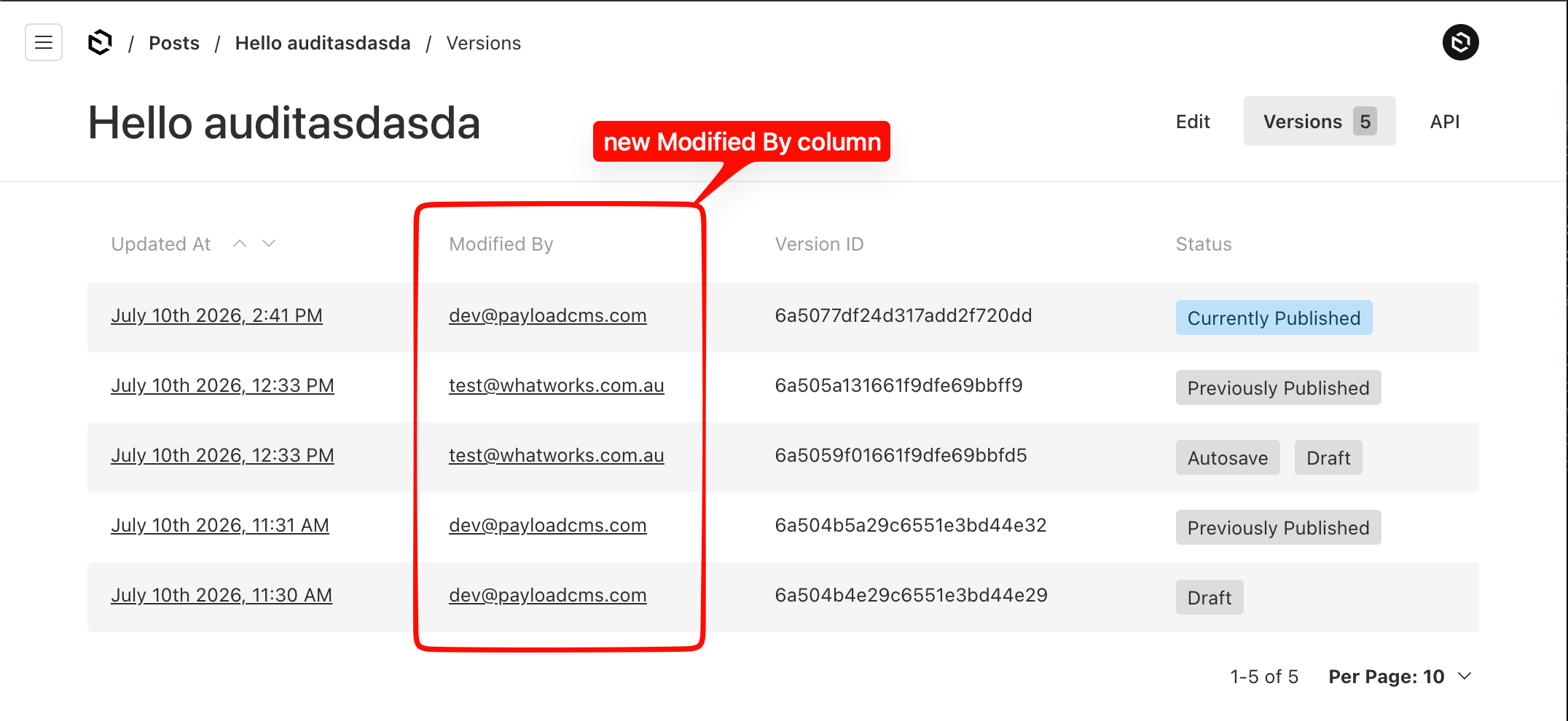
resolveUserLabel) — on the document, in the collection list view, and in the versions view — linked to the user document. - Replaces the versions list view with a faithful recreation of Payload's own view, extended with a per-version "Modified By" column.
- Supports multiple auth collections — attribution is stored as a polymorphic reference to whichever collection the acting user belongs to.
- Data-compatible with
@payload-bites/audit-fields— same default field names and the same stored value shape ({ relationTo, value }), so you can switch plugins without a migration.
Demo
Installation
pnpm add @whatworks/payload-audit-fields
Usage
import { auditFieldsPlugin } from '@whatworks/payload-audit-fields'
import { buildConfig } from 'payload'

export default buildConfig({
  // ...
  plugins: [
    // Register last so collections added by other plugins are audited too.
    auditFieldsPlugin(),
  ],
})
Then regenerate the import map so the admin panel can resolve the plugin's components:
payload generate:importmap
That's it — every collection and global now tracks createdBy and lastModifiedBy, and every entity with versions enabled gets the enhanced versions view.
Options
auditFieldsPlugin({
  // Which collections to audit. Defaults to all.
  // - true — every collection (default)
  // - ['posts', 'pages'] — only these
  // - { exclude: ['tags'] } — all except these
  collections: { exclude: ['tags'] },

  // Which globals to audit. Same semantics. Defaults to all.
  globals: true,

  // Auth collections users can be attributed to.
  // Defaults to every auth-enabled collection in your config.
  userCollections: ['users'],

  fields: {
    createdBy: {
      name: 'createdBy',
      label: 'Created By', // string | { [locale]: string } | (slug) => label
      // Escape hatch for full control over the generated field, e.g. delete
      // `field.admin.components` to restore the default relationship input:
      override: (field) => ({ ...field, index: true }),
    },
    // Set to false to only track one of the two fields:
    lastModifiedBy: { name: 'lastModifiedBy', label: 'Last Modified By' },
  },

  showInSidebar: false, // default false — fields render at the end of the main field area
  index: false, // default false — add a DB index to the fields

  // Custom attribution, e.g. attribute job/webhook writes to a bot user.
  // Return null/undefined to leave the fields untouched for that change.
  resolveUser: ({ req }) =>
    req.user ? { relationTo: req.user.collection, value: req.user.id } : null,

  // How attributed users are displayed — on the document and in the versions
  // view. May be async. Defaults to email → username → ID.
  resolveUserLabel: ({ user }) =>
    user.firstName ? `${user.firstName} ${user.lastName}` : (user.email as string),

  // The enhanced versions list view. Default: true.
  versionsView: {
    columnLabel: 'Modified By', // string | { [locale]: string }
  },
  // ...or `versionsView: false` to keep Payload's default view.
})
Behaviour
- Create sets both
createdByandlastModifiedByto the acting user. - Update sets
lastModifiedByand strips any incomingcreatedByvalue, so API clients cannot rewrite attribution after the fact. - Writes without a user (seeds, migrations, job runners, local API calls without
user/req) leave both fields untouched, so scripts can set them explicitly when needed — or useresolveUserto attribute them to a dedicated system user. - If an entity already defines a field with one of the configured names, the plugin leaves that entity's field and its values entirely alone.
- The plugin does not touch Payload's internal collections (
payload-preferences,payload-migrations,payload-locked-documents,payload-folders, …) — they are created after plugins run, are system-managed, or already carry their own user reference.
How users are displayed
On the document, audit fields render as a read-only label linking to the user document instead of the default (greyed-out) relationship input. The collection list view shows the same label in place of the raw relationship ID, and the versions view's "Modified By" column shows it too.
All three use resolveUserLabel to derive the label from the user document, which
is fetched with the viewing user's access rights — if the current user cannot
read the users collection, the raw ID is shown instead. The default resolver
returns user.email, falling back to user.username, then the ID.
resolveUserLabel may be async, so you can derive the label from anywhere:
resolveUserLabel: async ({ relationTo, req, user }) => {
  const profile = await req.payload.findByID({ collection: 'profiles', id: user.profile })
  return profile?.displayName ?? (user.email as string)
}
Versions view
For every audited entity with versions enabled, the plugin sets
admin.components.views.edit.versions to its own server view
(@whatworks/payload-audit-fields/rsc#AuditVersionsView) — unless you have already
customized that view, in which case yours wins.
The view is a faithful recreation of Payload's built-in versions list (same layout,
pagination, status pills, autosave badges, and trash support), with one addition: a
Modified By column showing who saved each version, linked to the user document.
It reads lastModifiedBy from each version snapshot and falls back to createdBy
for the initial version.
The vendored view internals come from [email protected] and degrade gracefully on
the older Payload versions in the peer range (version-gated props are simply
absent there); if Payload materially changes its versions view, update the
vendored files alongside the peer bump.
Migrating from @payload-bites/audit-fields
Field names, labels, and the stored value shape are identical by default, so swapping plugins requires no data migration. Differences to be aware of:
lastModifiedByis now also set on create (previously only on update).createdBycan no longer be overwritten through authenticated API updates.- Audit fields render at the end of the main field area by default; pass
showInSidebar: truefor the old placement. - Fields display the user's email as a link instead of a disabled relationship
input (customize via
resolveUserLabel, or restore the input viafields.createdBy.override). excludedCollections/excludedGlobalsbecomecollections: { exclude: [...] }/globals: { exclude: [...] }.- Attribution uses
req.user.collection, so users from any auth collection are recorded correctly (previously always the admin user collection).
Similar plugins

payload audit
Automatic audit logging of create, update, delete and auth events across all Payload collections
70712/wk4v3

activity log
Log activity on selected collections and globals in a dedicated activity log collection
660/wk114v3

authors info
Tracks who created, edited and published documents across collections and globals
6557/wk181v3

payload auditor
Audit logging for Payload collections and globals using hook operations, with buffered writes and automatic log cleanup
640/wk79v3
activity log
Chronological activity feed of document changes and user logins across all collections and globals
6129/wk15v3

payload hooks
Collection hook helper that logs Payload operations through the Nexload logger
550/wk2v?